
Storm & Sewer Drainage And Repair Deal
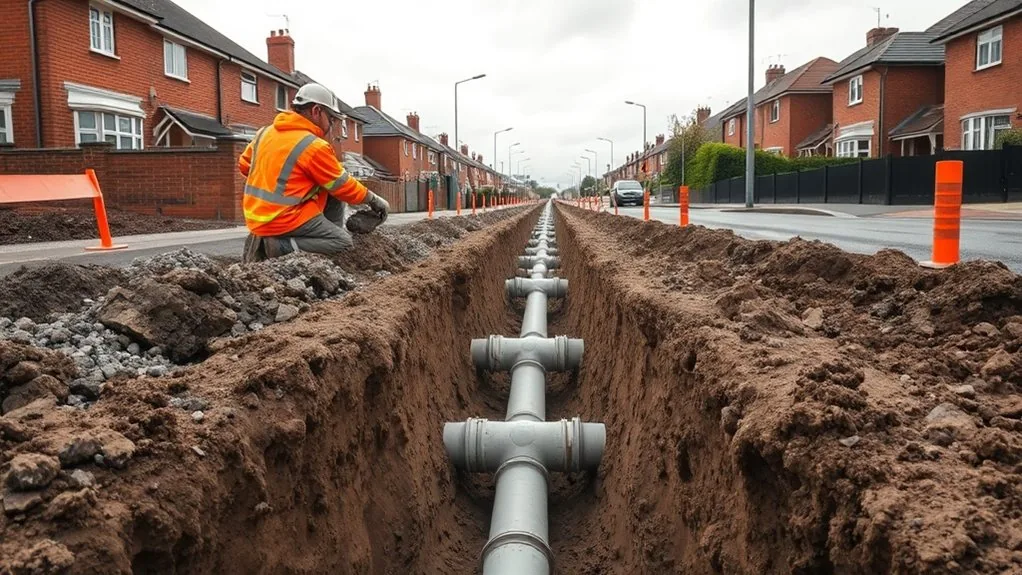
Dealing with blocked or damaged storm and sewer drainage in Deal can cause flooding, odours, and slow drains.
Ensuring your system is correctly sized, properly installed, and compliant with Building Regulations Part H and local standards is essential.
Call us for a fast quote or emergency callout to resolve your drainage issues promptly.
Storm and sewer drainage are two distinct yet interconnected systems that control how water is collected, conveyed, and discharged within Deal’s built environment. You’re dealing with separate networks: surface stormwater assets and foul/combined sewer assets, each governed by specific design standards and local authority approvals.
Storm drainage focuses on storm management, moving rainfall from roofs, drives, and paved areas into gullies, soakaways, or surface water sewers, discharging to watercourses where permitted. It’s sized for peak runoff, climate change allowances, and attenuation requirements.
Sewer drainage conveys wastewater from WCs, kitchens, and appliances to the public sewer. Here, sewer capacity, gradient, and venting are critical, ensuring self-cleansing velocities and compliance with Building Regulations, local sewer adoption criteria, and water company connection policies.
When you notice persistent yard flooding, slow or gurgling drains, sewage odours indoors, or unexplained water stains and mould, your property’s storm and sewer systems may no longer be operating within safe design parameters. These symptoms often indicate hydraulic overload, structural defects, or blockages that can escalate to non-compliance with local Deal drainage and environmental regulations. Recognising these early warning signs allows you to schedule professional inspection and corrective works before more serious structural or sanitary risks develop.
Ever notice sections of your lawn turning into a shallow pond after moderate rainfall and staying saturated for days? That’s a key indicator your storm drainage system isn’t managing surface runoff or groundwater correctly. Persistent yard water often points to inadequate grading, undersized or blocked yard drains, or missing connections to approved storm mains.
In Deal, repeated surface pooling near foundations, patios, or drive approaches can compromise structural elements, violate local drainage standards, and increase erosion and slip hazards. You’ll want a site assessment that measures slope, soil infiltration, and discharge paths, then designs code-compliant flooding solutions—such as regrading, French drains, catch basins, or tightline connections—to route stormwater to legal outfalls. Properly engineered systems prevent recurring saturation while aligning with Deal and King County regulations.
Beyond surface flooding in your yard, interior plumbing symptoms often reveal storm and sewer issues—slow-draining tubs or floor sinks, gurgling toilets, or bubbling utility sinks indicate that water and air aren’t moving freely through your drainage network. These hydraulic irregularities usually point to partial obstruction, inadequate venting, or surcharge in the combined or separate sewer laterals serving your Deal property.
When you ignore them, pressure fluctuations can accelerate joint failure, force fine solids into cracks, and increase the risk of backflow during heavy rain. Targeted drain cleaning and scheduled pipe maintenance help restore design flow rates and protect compliance with local Deal drainage bylaws, building regulations, and water authority standards, while also extending the service life of underground pipework and connections.
Although many homeowners dismiss it as a minor nuisance, persistent sewage odours indoors are a critical indicator that your Deal property’s storm and sewer drainage system isn’t maintaining proper hydraulic and atmospheric separation. That Indoor odour often means trap seals are being siphoned, vents are blocked, or illicit storm‑to‑foul connections are pressurising the system.
| Symptom | Likely Technical Cause |
|---|---|
| Odour near floor drains | Dry traps or defective trap primers |
| Smell after heavy rain | Cross‑connection with surface water drainage |
| Odour strongest at upper storeys | Inadequate stack venting / negative air pressure |
You shouldn’t just mask smells; you need targeted Ventilation solutions, trap reinstatement, and compliance checks against Building Regulations Part H. A drainage specialist can pressure‑test pipework, survey manholes, and confirm separation between storm and foul networks.
When you start seeing yellow‑brown water stains on ceilings or black mould tracking along skirting boards and external walls, it’s often evidence that your storm and sewer drainage isn’t conveying or discharging water within design parameters. These indicators usually mean moisture is bypassing intended pathways, saturating building fabric via capillary action or vapour drive.
Persistent water stains on external walls, below gutters, or near downpipes suggest defective rainwater goods, sub‑standard junctions, or undersized stormwater capacity relative to current rainfall intensities. Internally, mould growth at floor‑wall junctions can indicate rising damp from overloaded or damaged below‑ground drains, contrary to Part C and Part H requirements. You shouldn’t just clean affected areas; you need a drainage survey, CCTV inspection, and remedial works to restore compliant performance.
Because Deal’s storm and sewer systems operate under tight hydraulic limits and regulatory standards, most drainage issues can be traced to a few recurring causes. You’ll typically see problems where Drainage maintenance has lapsed, where materials are degrading, or where system capacity no longer matches surface runoff.
Typical triggers include:
These causes interact, accelerating structural fatigue and non-compliance with Deal’s drainage standards.
When you ask us to resolve a storm or sewer issue in Deal, we start with diagnosis and CCTV inspection to map the system, confirm pipe condition, and identify defects in line with local authority and Water Industry specifications. From there, we’ll select the most appropriate clearance method—typically high-pressure jetting or rodding and mechanical clearance—ensuring flows are restored without compromising structural integrity. If we detect fractures, root ingress, or structural failure, we’ll advise whether a targeted repair or trenchless relining is required to meet current regulatory standards.
Although many drainage issues present with similar surface symptoms, effective storm and sewer repairs in Deal always start with accurate diagnosis backed by CCTV inspection. You get a live, recorded survey of internal pipe conditions, allowing defects to be located to the metre and depth-logged for compliant excavation and reinstatement.
Using push-rod or crawler cameras, technicians identify root ingress, fractures, displaced joints, misconnections, and silt accumulation without unnecessary excavation. Each survey’s mapped against site plans and local authority requirements, supporting Section 106 and Building Regulations Part H considerations where relevant.
You’ll receive a written report, annotated stills, and footage you can review alongside clear Video tutorials and tailored Maintenance tips, helping you understand priority repairs, long‑term risk, and how to keep your system operating within regulatory standards.
Once defects and blockages are pinpointed, high‑pressure water jetting is deployed as the primary method for restoring hydraulic capacity in Deal’s storm and foul networks. You benefit from controlled High pressure jetting that scours pipe walls, dislodging silt, fats, roots, and construction debris without compromising structural integrity.
Our units match nozzle type, pressure, and flow to pipe diameter, material, and gradient, ensuring effective Drain cleaning while minimising risk of surcharge or backflow. We work to Deal and Water UK best‑practice guidance, including segregation of foul and surface water systems and responsible waste containment.
Jetting operations are programmed to maintain self‑cleansing velocities, protect manholes and laterals, and avoid undermining bedding, joints, or liners in rehabilitated sections.
In sections of Deal’s storm and foul drainage where jetting alone isn’t sufficient or appropriate, we deploy rodding and mechanical clearance to physically break down and extract obstructions. You benefit from controlled, targeted debris removal that protects pipe integrity and complies with local water authority standards.
| Method Aspect | Technical Detail |
|---|---|
| Application Zone | Small-bore laterals, root‑affected joints, silted gulleys, and complex manhole arrangements. |
| Tools Used | Rodding sets, mechanical cutting heads, and flex‑shaft machines sized to pipe diameter. |
| Control & Safety | Torque‑limited equipment, confined‑space protocols, and asset mapping before insertion. |
| Integration | Combined with hydrant maintenance and regulated discharge management to prevent surcharge. |
| Compliance | Works sequenced to align with Deal and Water Industry regulations on structural protection. |
You get a structurally focused clearance strategy that restores flow while minimising wear on ageing networks.
When jetting, rodding, and mechanical clearance stop being cost‑effective or risk aggravating defects, it’s a clear sign the drainage in Deal has reached the point where targeted repair or structural relining is required. You’ll typically see recurring blockages, deformation on CCTV, displaced joints, or infiltration/exfiltration indicating loss of pipe integrity.
At this stage, we assess structural condition, loadings, depth, and connectivity to determine whether excavation, patch repair, or full‑length resin‑impregnated lining is appropriate. We also consider Emergency preparedness: surcharge pathways, flood risk, and system resilience during extreme rainfall. All solutions are designed to align with Building Regulations, Water Industry standards, and local authority adoption criteria, while integrating with your ongoing drainage maintenance plan to minimise future disruption and lifecycle costs.
Need urgent drainage support across Deal? You’ll want a team that can mobilise quickly, assess risk, and stabilise your system before damage escalates. We operate on a rapid‑deployment model, with engineers positioned strategically across the county to minimise travel time and disruption.
When you call, we triage the issue—flooding, surcharge, odour, or structural failure—then dispatch with pre‑configured CCTV, jetting, and confined‑space equipment. This lets us restore hydraulic capacity fast, maintaining storm safety during heavy rainfall and preventing pollutant escape.
Our response procedures align with Water Industry Act requirements, Building Regulations Part H, and local authority guidance, so temporary measures don’t compromise compliance. You get fast, technically correct intervention that protects property, infrastructure, and downstream sewer maintenance programmes.
Rapid intervention is only part of the picture; understanding who’s legally and practically responsible for each section of your storm and sewer network is what keeps that system manageable long‑term. In Deal, you’re typically responsible for private drains within your boundary, including gutters, downpipes, and on‑plot rainwater management features like soakaways and attenuation crates.
Shared laterals, highway drains, and public sewers usually fall under the statutory water and sewerage company or the local highway authority. They handle structural integrity, capacity management, and regulatory compliance.
Your duty is to guarantee correct connections, permit access points, and fund drainage maintenance on private assets, so defects don’t impact the public network. Clear mapping of boundaries, easements, and adoption agreements is essential to avoid disputes and enforcement action.
Although emergency response restores short‑term function, preventing future drainage failures in Deal depends on a structured regime of inspection, maintenance, and compliance with current standards such as Building Regulations Part H and local LLFA guidance. You’ll need documented Maintenance tips and Prevention strategies that address hydraulic performance, structural condition, and environmental risk.
Key actions include CCTV surveys, scheduled jetting, and silt removal, all logged against asset plans. Confirm outfalls, manholes, and interceptors remain accessible, vented, and free‑flowing, with any defects graded and prioritised.
Because drainage failures in Deal are as much about design and compliance as they are about blockages, you benefit from a contractor that combines specialist diagnostics with a clear understanding of national and local standards. You get engineered storm and foul systems designed for site-specific loading, gradients, and infiltration, not generic layouts that fail under stress.
We integrate storm prevention into every design: attenuation, backflow control, correctly sized pipework, and compliant discharge points. Our CCTV surveys, condition grading, and flow assessments give you measurable data, so you know precisely what’s required.
You also gain from structured drainage maintenance plans that align with Water Industry Specifications and Building Regulations, reducing unplanned failures and insurance risk while protecting your property’s structural integrity and long-term asset value.
You’ll naturally want clear answers on response times, cost structures, and whether any initial remedial work is safe for you to attempt yourself. In this section, we address these points with reference to typical site conditions, system capacity, and compliance with current UK and local Deal drainage regulations. You’ll also see how our coverage across Deal is structured, so you can quickly confirm that your property falls within our operational area.
How fast can a qualified drainage team actually respond to storm and sewer issues in Deal depends on factors like asset location, access constraints, and the severity of the incident, but properly resourced contractors typically offer 24/7 emergency attendance, often within 1–2 hours for priority callouts. You’ll usually get faster mobilisation where there’s clear storm safety risk, internal flooding, or surcharge affecting public highways.
For routine sewer maintenance, CCTV surveys, and minor defects, you’re typically looking at planned attendance within 24–72 hours, aligned with local authority and water company coordination. In conservation areas, on classified roads, or near critical infrastructure, response may include additional permitting checks, traffic management design, and confined-space compliance, which can extend lead-in but guarantees works remain fully regulation compliant.
Rapid response is only one part of planning storm and sewer works in Deal; the other is understanding likely cost ranges and what drives them. You’ll find that Cost estimation depends on drainage type (surface, foul, combined), pipe diameters, run length, access constraints, and whether you’re working on private land or connecting to a public sewer.
Typical cost drivers include CCTV surveys, excavation depth, reinstatement of hard surfaces, and any need for pumps, attenuation crates, or oil interceptors. Regulation‑linked items—Thames Water or Southern Water approvals, Section 106 sewer connections, and Building Regulations compliance—also affect Budget planning.
A competent contractor should give you a staged, itemised quotation covering investigation, design, installation, testing, and certification.
Although some minor storm and foul drainage issues can be investigated safely on a DIY basis, it’s critical to distinguish between simple checks and works that legally or practically require a competent contractor in Deal. You can visually inspect gullies, lift lightweight inspection chamber lids, and clear leaves or loose silt from surface channels, following basic DIY tips and safety precautions such as gloves, eye protection, and stable footing.
However, you shouldn’t enter manholes, dismantle pipework, or use chemical drain cleaners in combined systems. Anything involving shared sewers, road connections, alteration of gradients, or excavation near foundations must comply with Building Regulations and water company standards, so it’s not suitable for DIY. If in doubt, stop work, document observations, and seek professional assessment.
Once you’ve decided a drainage issue shouldn’t be tackled DIY, the next step is confirming whether a qualified contractor can lawfully and practically attend your site. You’re right to ask about coverage, because storm safety and drainage maintenance are governed by local authority boundaries, highway consents, and water company asset maps.
We typically cover most of Deal, but exact eligibility depends on access, adoption status of the sewer, and whether works fall under Section 106 (new connections) or Section 98/185 (diversions/alterations).
| Area Type | Typical Locations | Notes on Service Scope |
|---|---|---|
| Urban Hubs | Maidstone, Medway Towns, Ashford | Full installation, repair, CCTV surveys |
| Coastal Zones | Margate, Folkestone, Whitstable | Tidal/groundwater‑aware designs |
| Rural Catchments | Weald villages, farms, estates | Soakaways, attenuation, access-dependent |
Always confirm coverage during your initial site assessment.
Yes, we provide CCTV drain surveys before any storm or sewer drainage work. The survey uses a camera to inspect the inside of pipes and identify issues such as cracks, root ingress, misconnections, and capacity problems. The footage and reports help with planning applications, build-over agreements, and insurance-backed repair specifications.
Yes, you can get help with planning permission for new storm drain connections. Assistance is available for preparing application documents, including drainage layout drawings and hydraulic calculations. Support also covers compliance with local authority and water company standards, connection details, capacity checks, and sustainable drainage proposals.
For long-lasting storm and sewer pipes, you typically use uPVC, HDPE, or concrete materials. uPVC pipes have smooth hydraulics and resist chemicals, HDPE pipes are flexible with strong joint integrity, and concrete pipes are suited for high-load, large-diameter installations. The choice depends on factors such as loading, cover depth, and soil conditions, while meeting standards like BS EN 1401, BS EN 13476, and local adoptable requirements (e.g. Sewers for Adoption).
Yes, we offer ongoing maintenance contracts for commercial drainage systems. These include scheduled inspections, jetting, and CCTV surveys to ensure compliance with current drainage regulations. Contracts can also provide priority emergency response with defined SLAs, along with condition reports and maintenance logs to keep your drainage network fully documented and operational.
Yes, you can receive assistance with insurance claims for flood damage or drainage failures. This includes help with gathering evidence such as CCTV survey reports, as-built drainage layouts, and defect cause analysis. You will also be guided to ensure your documentation meets insurer requirements and relevant UK regulations and standards, with support to distinguish pre-existing defects from incident-related damage to clarify liability and strengthen your claim.
When stormwater backs up or foul water drains slowly, you’re not just facing an inconvenience—you’re facing a potential compliance, structural, and hygiene problem that needs prompt, expert resolution. You need your storm and sewer drainage assessed, designed, and rectified in line with current Building Regulations, Sewers for Adoption, and local authority requirements.
We’ll review gradients, pipe condition, manhole accessibility, and connectivity to public sewers or soakaways, ensuring your Rainwater management and Urban drainage components operate as an integrated system. That means checking attenuation volumes, backflow protection, and separation of foul and surface water lines.
You’ll receive clear recommendations, costed options, and a defined programme so remedial works, new installations, or connections are completed safely, legally, and with long-term performance in mind.