
Trenchless Cable Installation in Deal
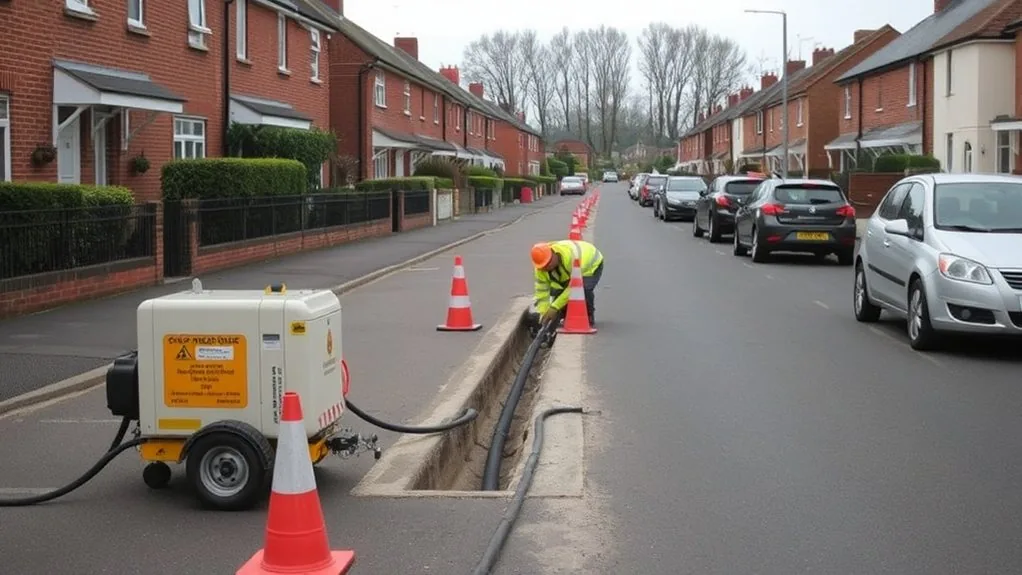
Upgrading or installing underground power and data cables can be disruptive to roads, driveways, and sensitive areas. Trenchless cable installation in Deal minimises this impact by using precise drilling and controlled cable pulling.
This method helps to protect existing services and maintain safety standards.
For a fast quote or emergency callout, please get in touch.
Although it’s often grouped with traditional excavation, trenchless cable installation is a distinct set of methods for installing or replacing power, data, or communication cables underground with minimal surface digging. You typically use guided boring, horizontal directional drilling, or pipe pulling to create a controlled underground path, then install ducts or cables through that path.
You start with surveys and utility locating to map existing services and ground conditions. This planning stage lets you control line and level, reduce clashes, and protect cable durability by avoiding sharp bends, over-tension, or abrasion. You also manage drilling fluids, spoil, and reinstatement to meet environmental and highway standards, helping control installation costs while maintaining safety for workers, nearby utilities, and the public.
Once you understand how trenchless cable installation works, the next question is when it’s the right choice for a project in Deal. You typically need it when open-cut trenches would be unsafe, disruptive, or impractical.
Consider trenchless methods when you must:
In these scenarios, trenchless installation helps you maintain operational continuity, comply with regulations, and reduce project risk.
When you commission trenchless cable installation in Deal, the process starts with a detailed site survey and planning phase to map utilities, assess ground conditions, and design a safe drill path. Technicians then carry out guided drilling operations, install and protect the new cable within the bore, and guarantee all components are correctly seated and shielded. Finally, they complete testing and site restoration, confirming performance, electrical safety, and structural integrity before returning the surface to its original condition.
Before any trenchless cable installation in Deal begins, a detailed site survey and planning phase establishes whether the route is feasible, safe, and compliant. You’ll have existing utility records checked, manhole and chamber positions logged, and access constraints assessed. Technicians then carry out soil testing to confirm ground composition, moisture levels, and potential obstructions, which directly inform bore depth, alignment, and tooling selection.
You’ll see risk assessments completed for ground movement, strike hazards, and traffic or pedestrian interfaces. Set-out points and cable entry/exit locations are precisely marked, with working areas defined to protect the public and your property. Finally, equipment calibration is scheduled in line with site conditions, ensuring measurement accuracy, reliable operation, and adherence to UK safety and environmental standards.
So how does guided drilling actually create a precise underground route for your new cables in Deal? Technicians position a horizontal directional drilling (HDD) rig at the launch point, then set the drill angle and torque based on the surveyed alignment. A steerable drill head, fitted with a transmitter, advances along a pre‑planned bore path.
A tracking operator continuously monitors depth and heading, relaying corrections to maintain separation from existing utilities and sensitive structures. Equipment safety checks—pressure limits, return‑flow monitoring, and emergency shutdowns—are enforced throughout to prevent blowouts or strikes. Drilling fluid is carefully managed and recycled to stabilise the bore and minimise environmental impact, with spoil captured and removed from site rather than left to contaminate local ground or waterways.
Once the pilot bore is confirmed, the crew prepares the drilled path for cable placement by attaching a reamer and then a pulling assembly sized to the cable and duct specification. You’ll see the bore enlarged in controlled passes, maintaining line and grade while creating sufficient annular space for lubrication and thermal performance.
High-spec ducts and insulation materials are selected to maximise cable durability and electrical integrity. The cable’s pulled under constant tension monitoring, with swivel joints preventing twist and sheath damage.
| Stage | Key Control Point | Risk Mitigated |
|---|---|---|
| Reaming | Bore diameter, fluid returns | Collapse, inadvertent breakout |
| Duct installation | Depth, alignment, compaction | Third‑party utility conflict |
| Cable pulling | Tension, speed, lubrication | Insulation and sheath damage |
Protective spacing and depth guarantee long-term mechanical and thermal protection.
With the cable installed and jointed, attention shifts to proving the system’s integrity and returning the site to its pre‑works condition. You’ll see high‑voltage or insulation‑resistance testing carried out to verify cable durability, followed by sheath and continuity tests to confirm correct phasing and earthing. Test results are logged against design criteria, and any non‑conformances are investigated before energisation.
You then move into controlled backfilling of launch and reception pits, compacting in layers to protect the circuit and prevent future settlement. Surface finishes—tarmac, block paving, or soft landscaping—are reinstated to match existing levels and lines. Throughout, equipment maintenance is critical: properly serviced winches, compressors, and test sets reduce safety risks and help you deliver a durable, low‑impact installation.
Although both methods aim to place cables safely and reliably underground, trenchless cable installation differs fundamentally from traditional excavation in how it accesses and disturbs the ground. With trenchless techniques, you typically drill a guided bore between launch and reception pits, then pull ducts and conductors through, protecting cable insulation from abrasion and moisture ingress. This controlled path supports electrical safety by reducing unintended contact with other utilities and minimising damage risks.
In contrast, traditional excavation requires open trenches along the full route. You remove soil, shore the sides, manually place cables, then backfill and compact. This exposes cables, workers, and third-party services, demanding more intensive temporary works, access controls, and inspection to maintain electrical safety and long-term system integrity.
Having compared trenchless cable installation to open-cut excavation, you can now focus on the practical advantages it brings to projects across Deal. By steering away from continuous trenches, you minimise surface disturbance, shorten programme durations, and reduce interface risks with existing utilities. Trenchless technology also supports long-term asset integrity by keeping new routes deeper and better protected.
You can picture the benefits in three key areas:
Across Deal’s built-up streets, rural lanes, and industrial estates, trenchless cable installation adapts effectively to both domestic and commercial environments, allowing you to introduce new power, data, and EV charging circuits without extensive surface disruption. In domestic settings, you can route cables beneath driveways, patios, and landscaped gardens, protecting outdoor aesthetics and minimising reinstatement. Targeted entry and exit pits keep noise, dust, and access restrictions tightly controlled.
On commercial and industrial sites, trenchless methods let you upgrade mains feeds, fibre links, and control cabling beneath car parks, service yards, and live production areas while operations continue safely. You reduce excavation volumes, vehicle movements, and spoil removal, lowering environmental impact and safety risks. Careful planning, utility mapping, and continuous monitoring help you maintain compliance and protect existing buried services.
From initial survey to final test and handover, our trenchless cable installation service in Deal’s towns and villages is built around disciplined planning, safety control, and clean execution. You get a structured process: utility mapping, ground investigation, and route design based on depth, load, and existing infrastructure.
We then select the appropriate trenchless method, typically horizontal directional drilling or guided moling, to install ducts with controlled line and grade. Your power cables are pulled through using calibrated winches, with tensile limits strictly observed to protect cable insulation and terminations.
Throughout, we implement exclusion zones, live-service proximity checks, and continuous monitoring of drilling fluids. Final activities include sheath integrity checks, insulation resistance testing, and circuit verification before the system’s energised and documented.
You’ve seen how our trenchless cable installation process in Deal is built on controlled methods and verifiable testing; the reason clients choose us is the way we apply that discipline to real-world constraints on their sites. You get engineers who assess ground conditions, existing utilities, and load requirements before specifying any bore path.
We prioritise cable durability by matching ducting, bedding, and depth to the electrical, mechanical, and thermal demands of your network. Pulling tensions, bend radii, and jointing are all monitored and recorded, reducing future failure risk.
Our methods minimise environmental impact by reducing open excavation, spoil removal, and noise. Robust safety plans, traffic management, and live-service protection mean your project’s delivered with documented compliance and controlled, predictable outcomes.
You’ll naturally want clear answers on how long trenchless cable installation takes, how its costs compare to open-cut trenching, and whether your specific location in Deal is covered. In this section, you’ll see how project duration is assessed based on route length, ground conditions, and existing utilities, always with safety-critical checks built into the schedule. We’ll also outline the main cost drivers and set out our Deal coverage so you can quickly confirm feasibility for your site.
Although every project has its own variables, trenchless cable installation in Deal typically ranges from a few hours for short, straightforward runs to several days for longer, more complex routes. Time depends on ground conditions, route length, existing utilities, and the specification required for cable durability. Your contractor will assess these factors during the initial survey and select installation equipment that matches the soil type, depth, and safety constraints.
| Project Type | Typical Duration | Key Time Factors |
|---|---|---|
| Short domestic run | 3–6 hours | Access, obstructions, reinstatement |
| Medium commercial | 1–2 days | Utility clashes, bore accuracy |
| Long route | 2–4 days | Multiple drill shots, joint bays |
| Complex geology | Variable | Ground stability, fluid management |
| Night-time works | Phased over several nights | Noise limits, traffic management |
In many Deal projects, trenchless cable installation isn’t always cheaper on day one than open-cut digging, but it often delivers lower total cost once reinstatement, traffic management, and disruption are factored in. You avoid extensive excavation, spoil removal, and full-depth carriageway or footway reconstruction, which quickly inflates traditional trenching costs.
With trenchless techniques, you typically pay for specialist planning, drilling, and tracking, but you minimise surface damage and programme time. That reduces lane rental charges, permits, and traffic management durations.
You also gain lifecycle savings. Controlled installation conditions help protect cable insulation, reducing the risk of future faults and reactive repairs. Precisely installed ducts improve cooling and long-term energy efficiency, which can be critical for high-load power circuits and data infrastructure.
Wondering if your part of Deal’s covered for trenchless cable installation? In most cases, yes. We typically operate across urban, suburban, and rural locations, provided site access is safe and we can comply with local regulations and utility records.
| Typical Area Type | What We Assess On-Site |
|---|---|
| Urban streets | Existing utilities, traffic management needs |
| Suburbs | Driveways, gardens, boundary clearances |
| Rural lanes | Ground conditions, access for machinery |
| Commercial sites | Service routes, operational constraints |
Before confirming your project, we’ll review plans, conduct utility searches, and check council requirements. Our team then designs a trenchless method—such as directional drilling—that minimises disruption while meeting safety protocols.
If you’re unsure, share your postcode and site details; we’ll confirm feasibility and any constraints in advance.
Yes, you need permission from Deal County Council before trenchless cable installation in the highway. You must apply under the Deal Permit Scheme and obtain any required approvals, such as Section 50 or street works permits. You should submit method statements, traffic management plans, and utility searches, and wait for permits to be granted before starting work.
Yes, trenchless methods can be used to install fibre, power, and EV charging cables together. Separate ducts or correctly spaced multi-ducts should be designed to protect cable durability and minimise interference. It is important to assess soil conditions, thermal limits, and pulling tensions to control installation costs, while following BS 7671, utility separation standards, and keeping accurate as-built records for safety and reliability.
Trenchless cable installation can safely operate within 0.5 to 1.0 metres of existing utilities. The exact safe distance depends on factors such as ground conditions, pipe material, and utility owner requirements. Utility detection methods like records, CAT/Genny, and GPR are used to define exclusion zones, which are then verified by trial holes and continuous tracking. Safety measures include reducing drill pressure, controlling steering, and having standby responses when working near gas or high voltage utilities. Final separation distances are confirmed through as‑built surveys.
Your home or business insurance may cover trenchless installation work, but you must check your policy to be sure. Confirm if trenchless installation is considered "building works" and review exclusions related to groundworks, subsidence, or damage to utilities. It is important to ask your insurer about coverage for third-party liability, contractor negligence, and reinstatement costs. Use an accredited installer and obtain method statements, as your insurer may require these to process any future claims.
Yes, evening or weekend trenchless installation appointments are usually available in Deal, depending on crew availability and local noise regulations. Availability and scheduling can be checked and confirmed based on customer preferences. Engineers carry out a pre-site survey, plan safe access routes, and adjust risk assessments and notifications for out-of-hours work.
Once you’ve confirmed that trenchless installation is appropriate for your project, the next step is to request a detailed, itemised quote from a qualified contractor in Deal. You’ll want a site survey first, so the engineer can assess ground conditions, existing utilities, access points, and any constraints affecting Cable safety.
Your quote should clearly break down Installation costs: design, ground scanning, drilling or moling, duct and cable supply, jointing, reinstatement, and traffic or pedestrian management if required. Ask for method statements and risk assessments so you can verify compliance with UK regulations and utility provider standards.
Verify how emergency procedures, service shutdowns, and testing will be handled. Finally, confirm the quote includes timescales, warranties, and any planned maintenance or inspection options.